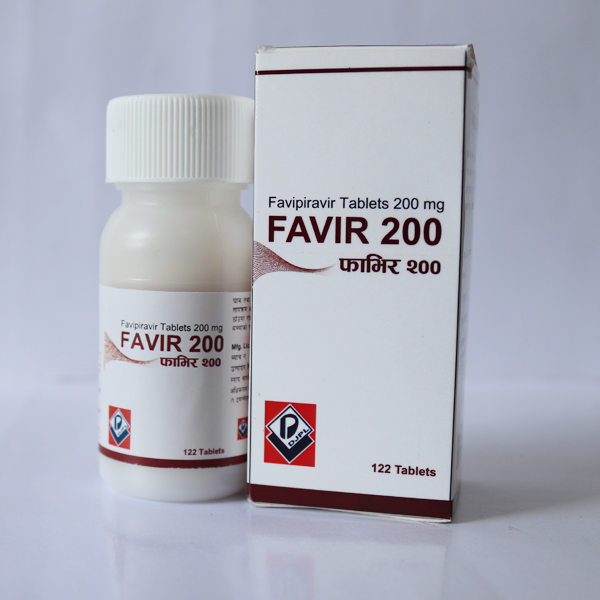
FAVIR 200
Favipiravir 200 mg Tablets
Favipiravir is an oral antiviral selectively inhibiting RNA Polymerase necessary for viral
replication.
I. Novel or re-emerging influenza virus infections.
II. Investigational use for novel corona virus, SARS-CoV-2 infection.
II. Investigational use for novel corona virus, SARS-CoV-2 infection.
As directed by registered medical practitioner only.
Since the elderly often have reduced physiological functions, Favipiravir should be
administered with care to them by monitoring their general conditions.
Favipiravir has not been administered to children.
Favipiravir is distributed in sperm. When administering the drug to male patients, explain
fully the risks and instruct thoroughly to use most effective contraceptive methods in
sexual intercourse during and for 7 days after the end of treatment (men must wear a
condom). In addition, instruct not to have sexual intercourse with pregnant women.
Since early embryonic deaths and teratogenicity have been observed in animal studies for
Favipiravir, do not administer the drug to women known or suspected to be pregnant. When
administering Favipiravir to women of childbearing potential, confirm a negative pregnancy
test result before starting the treatment. Explain fully the risks and instruct thoroughly
to use most effective contraceptive methods with her partner during and for 7 days after the
end of the treatment. If pregnancy is suspected during the treatment, instruct to
discontinue the treatment immediately and to consult a doctor.
When administering Favipiravir to lactating women, instruct to stop lactating. The major
metabolite of Favipiravir, a hydroxylated form, was found to be distributed in breast milk.
Women known or suspected to be pregnant. Early embryonic deaths and teratogenicity have been
observed in animal studies. Patients with the history of hypersensitivity to any ingredients
of the drug.
Favipiravir is not metabolized by cytochrome P-450 (CYP), mostly metabolized by aldehyde
oxidase (AO), and partly metabolized by xanthine oxidase (XO). The drug inhibits AO and
CYP2C8, but does not induce CYP. Potential drug-drug interaction due to AO inhibition should
not be ignored in the clinical setting. When combined with Favipiravir, the recommended
maximum daily doses of acetaminophen is 3 g.
There is increase of plasma level of Favipiravir in patients with liver function impairment.
Inactive oxidative metabolite T-705 M1 is excreted by the kidneys. Caution should be taken
while giving Favipiravir to renal and hepatic impaired patients.
Keep in a dry place at a temperature below 30°C protected from light and moisture. Keep away
from the reach of children and pets.
1 Bottle × 122 Tablets.
Downloads:
Favir 200 (Technical Info) (click here)
Email for Favir : info.favir@deuralijanta.com